

What Is GEO? How AI Answer Engines Find and Cite Sources
AI answer engines split a question into sub-searches, find pages in an index or in their own crawlers' data, put them into the LLM's prompt and tie the answer to sources; this live retrieval channel is completely separate from the model's training data. We cover how Google, Copilot, ChatGPT search, Perplexity and Claude find sources, and why GEO is still SEO.
Version note: This post is based on Google's AI (Artificial Intelligence) features documentation and AI optimization guide, and on the OpenAI, Anthropic and Perplexity crawler documentation, as of November 2026.
Guess First
A reader asks ChatGPT "Is Async in Practice a good book?" and Bookstore's review page shows up as a source under the answer. The next day someone on the team adds User-agent: GPTBot and Disallow: / to robots.txt, because they want "our content not to be used for AI training". Will Bookstore still show up as a source for the same question next week? And does the same page need an extra file or markup to appear in an AI Overview on Google?
Ten Blue Links versus a Generative Answer
Classic search gives you a ranked list; you decide which result to click and which source to trust. AI answer engines do part of that step for you: they read several pages, write a single answer and tie some of its sentences to sources. Google's AI Overviews and AI Mode, Microsoft Copilot, ChatGPT search, Perplexity and Claude with web search turned on belong to this family.
For a site owner the result is this: there are now two separate questions. The first is the classic one, "does my page rank?". The second is new, "does my page get into the answer's sources, and is it cited?". GEO (Generative Engine Optimization) is the name of the work that deals with the second question. The goal of this series is to answer it away from the hype, based on official documentation and independent research, and to label tactics without evidence as such.
Retrieval, Grounding, Answer and Citation
The process running inside an AI answer engine is a large-scale version of RAG (Retrieval-Augmented Generation), the mechanics we covered in the "LLMs and RAG" post of the LLM (Large Language Model) Fundamentals series. Google writes in its own guide that its AI features use retrieval-augmented generation, that is, grounding, and query fan-out. The steps are roughly these:
- Query fan-out: the question is split into several searches aimed at subtopics and different data sources. According to Google, that's why AI features can show a wider and more diverse set of links than classic search.
- Retrieval: for each sub-search, candidate pages are found in an index or in the data the engine's own crawler collected.
- Grounding: the relevant parts of the retrieved pages are added to the LLM's prompt; the model writes the answer based on those parts.
- Citation: sentences of the answer are linked to the source pages.
I won't repeat here how embeddings, chunks and the context window work in this process; the "Embeddings and Similarity for LLMs" post of the LLM Fundamentals series and the RAG series exist for that. What matters from a GEO point of view is this: for a page to be cited, it first has to be a candidate in the retrieval step. A page that doesn't get into retrieval can't be "liked" by the model. That takes us back to the middle of classic SEO (Search Engine Optimization): crawling, indexing and ranking.
Two Channels: Training Data and Live Retrieval
There are two completely separate ways to show up in AI answers, and most of the confusion comes from mixing them up.
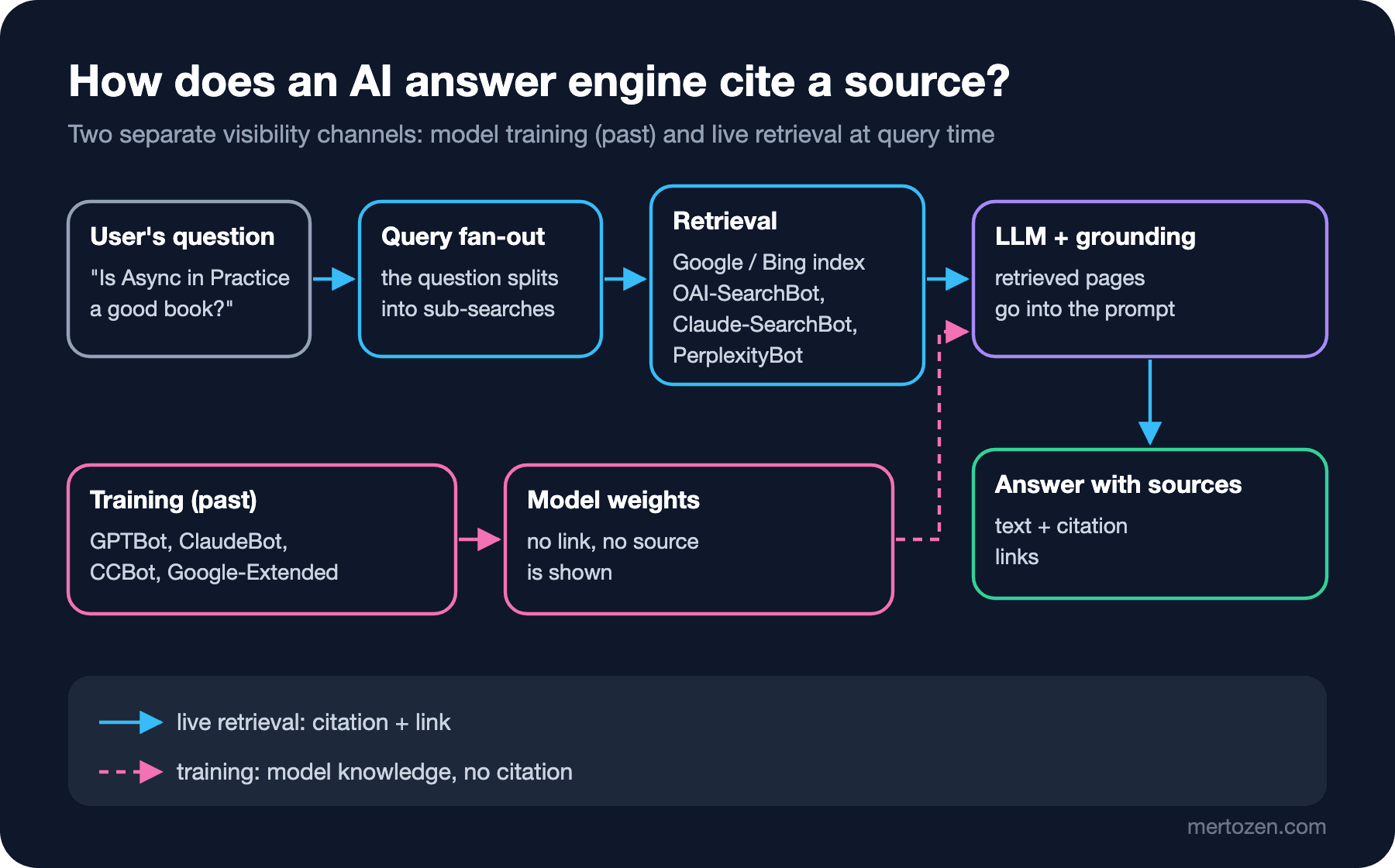
The training channel belongs to the past. Content collected by crawlers such as GPTBot, ClaudeBot and CCBot, and controlled with Google-Extended, may end up in the training data of future models. When a model "knows" something from its training, it usually shows no link in its answer; the content has melted into the model's weights. Don't expect traffic or citations from this channel.
The live retrieval channel belongs to query time. Pages indexed by search crawlers such as OpenAI's OAI-SearchBot (OAI: OpenAI), Claude-SearchBot, PerplexityBot, Googlebot and Bingbot are found during the query, go into the prompt and are cited with a link. Citations and referral traffic come from this channel.
Here's the answer to the opening question. According to OpenAI's documentation, blocking GPTBot signals that your content shouldn't be used to train OpenAI's foundation models; appearing in ChatGPT search is determined by OAI-SearchBot, and the two settings are independent. So blocking GPTBot doesn't, on its own, stop Bookstore from appearing as a source in ChatGPT search answers. The robots.txt equivalents of these decisions are the subject of the third post in the series.
Where Do the Engines Get Their Sources?
Each engine's retrieval side is different, and that difference determines which control affects what. What the official documentation says:
| Engine | Finding sources | Token that controls visibility | Note |
|---|---|---|---|
| Google AI Overviews, AI Mode | The Google Search index, query fan-out | Googlebot | Google-Extended doesn't affect Search |
| Microsoft Copilot | The Bing index | Bingbot | Citations appear in the Bing AI Performance report |
| ChatGPT search | OAI-SearchBot and, at times, third-party search providers | OAI-SearchBot | GPTBot is for training only |
| Perplexity | PerplexityBot | PerplexityBot | Perplexity writes that PerplexityBot doesn't collect training data |
| Claude | Claude-SearchBot, and Claude-User on user request | Claude-SearchBot | ClaudeBot is the training crawler |
The first row is critical for Google: according to Google's "AI features and your website" page, for a page to be shown as a supporting link in AI Overviews or AI Mode it only needs to be indexed and eligible to be shown with a snippet; Google writes that there are no additional technical requirements. The AI optimization guide published in May 2026 adds one condition: the site has to be included in the generative AI setting in Search Console. That setting has existed since June 2026 and it's an opt-out control: the site is included unless you turn it off. Details in the third post of the series.
On the ChatGPT search side, OpenAI's help page says ChatGPT sometimes works with other search providers and rewrites your question into one or more targeted queries sent to those providers. So whether a page appears in ChatGPT may depend not only on OAI-SearchBot but also on those providers' indexes. Which provider is used when is not public.
GEO, AEO and "LLM SEO": Different Names for the Same Work
The term "GEO" comes from the paper Aggarwal and colleagues published in November 2023 and presented at KDD (Knowledge Discovery and Data Mining) 2024. Names like AEO (Answer Engine Optimization), "LLM SEO" and "AI SEO" describe roughly the same work. Google's position is clear: according to its AI optimization guide, optimizing for generative AI search is optimizing for the search experience, and therefore still SEO. Google refers to AEO and GEO as different names for this work.
That stance is more than a marketing line, because it is technically correct: Google's AI features rest on its core ranking and quality systems; Copilot uses Bing's index. The first condition for appearing in these engines is being well represented in their retrieval layer, that is, in a search index. What's different is measurement, bot management and some engine-specific controls. This series focuses on those differences; it leaves the shared foundation to the SEO Fundamentals and Technical SEO series.
The Bookstore Example: The Journey of a Question
Let's follow the opening question through the engine's eyes. "Is Async in Practice a good book?" can be split by fan-out into several sub-searches: the book's content, its author, reader reviews, alternatives on the same topic. If Bookstore's review page gets into retrieval for one of these sub-searches, say "Async in Practice review", the relevant part of the page is added to the prompt. The model writes a sentence like "the book teaches cancellation and backpressure hands-on" and links it to Bookstore.
Every link in that chain is a checkpoint. If the search crawler can't fetch the page, it can't get into retrieval. If the review body is loaded with JavaScript and the crawler doesn't run JavaScript, the part that goes into the prompt is empty. If the page carries nosnippet, Google doesn't use it as direct input to AI Overviews and AI Mode. If the content says nothing original, there's no reason for it to be chosen among hundreds of pages giving the same information. And how much weight each factor carries has not been disclosed by any engine.
Production Notes
Make two separate decisions for the two channels. "Do we want to be used in model training?" and "do we want to appear as a source in AI answers?" are different questions, managed with different bots. It's a content policy decision; the technical team prepares the options, the site owner decides.
Check the classic foundation first. If a page isn't in Google's index it can't be in AI Overviews either; if it isn't in Bing it won't appear in Copilot. The diagnosis tree from the SEO Fundamentals series is the first step here too.
Be realistic about measurement. Measuring visibility in AI answers is much weaker than in classic search; we'll see in detail which data you can get from which channel in the last post of the series.
Common Pitfalls
Thinking blocking a training bot means "leaving AI". Blocking GPTBot or ClaudeBot doesn't affect the bots that determine search visibility; the reverse is also true.
Taking the model "knowing" something for a citation. Knowledge from training data carries no link; what brings traffic is a citation in live retrieval.
Treating GEO as a discipline independent from SEO. On the Google and Bing side, AI features rest on the same index and the same quality systems.
Generalizing one engine's behavior to all engines. Something Google says is "not needed" may be different for another engine; each engine's documentation has to be read separately.
A Small Experiment
★☆☆ Open your site's robots.txt and label each line as the "training" or "search" channel according to the table in this post.
★★☆ Pick a question from your own field, ask it to two different AI answer engines and compare the sources they give. How many sources overlap? Ask the same question again a day later; did the sources change? Write down why this small experiment can't count as a measurement.
★★★ Write down the retrieval chain for your site's three most important pages: which crawlers can reach them, is the content in the initial HTML (HyperText Markup Language), are there snippet controls, is the page indexed in Google and Bing?
In the next post we open the AI optimization guide Google published in May 2026: what Google wants you to do, and what it explicitly considers unnecessary, such as llms.txt, chunking and "special markup for AI".